As I have crawled along the jammed-up freeway in Marin, watching hybrid after hybrid fly by me in the car pool lane (a privilege that's just ended), I would never have guessed that cars with green technology still only represent 2% of the U.S. market.
It may take a while for the rest of America to reach the level of green car penetration we have in Marin but the growth rate is impressive (twice as fast as conventional cars). J.D. Power estimates that, in the next five years, the number of hybrid and electric car models will increase fivefold, from 31 today to 159 by 2016.
Such a fast-growing category combined, as it is, with fast-changing technology is full of risk and opportunity. As the field gets more crowded, Prius, the category leader, will try and stay ahead of the pack while new players like Tesla look for a way to break in. Here are the risks and challenges for both brands with doomsday benchmarks added for effect.
 |
| Smug1 by Gamma Man (Flickr) |
As the current #1, Prius has to fend off the competition and it's planning to do that in classic leader fashion by launching new models to broaden its range and cater to different car buyer segments. It's trying to make sure it doesn't get outflanked. Its first new model will be the family-sized Prius V, then a smaller Prius C and sometime after a non-hybrid plug-in Prius.
Doomsday benchmark: aol
The worst case scenario for Prius is that it becomes a victim of its own success, too strongly associated with hybrid technology (vs. newer, greener alternatives), too associated with a certain type of early-adopting, holier-than-thou consumer and too associated with a particular period in the evolution of the green car market. aol was forever associated with its CDs offering more and more trial hours and, as Bill Visnick, an analyst with Edmunds Auto Observer, has pointed out Prius has its own association problems: "The fact is that it's very much known as a weeny sort of a car, and sort of a car for people who are driving too slow in the fast lane."
 |
| Photo by NRMAdriversseat (Flickr) |
Doomsday benchmark: Webvan
The worst case scenario for Tesla is that it can't make the leap from hype to mass manufacturer in the one fell swoop now needed. That leap proved too much for Webvan, another company that committed millions to infrastructure before its business was established. Transitioning from a niche to mainstream is difficult enough without adding in a huge plant that needs to be kept running.
There's no comparison really about the prospects of Prius vs. Tesla--the easy and safe bet is on Prius. It has some real challenges but nothing compared to the level of difficulty of Tesla, where the specter of DeLorean lurks in the perhaps not-too-distant shadows (as others have pointed out).


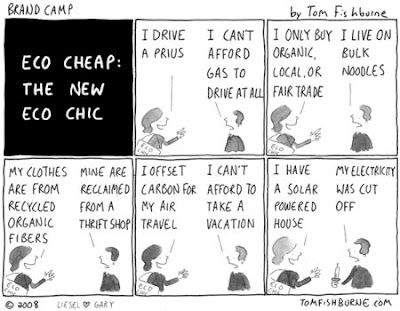 Even better than buying the right thing is buying nothing at all