Showing posts with label Financial Crisis. Show all posts

Saturday, May 29, 2010

Six of the Best: We're all indebted edition

Happy Memorial Day Weekend! Summer arrived just in time in San Francisco. Time to head to the beach but, first, here are six of the best, most of which come from the "likes" of Facebook friends:

1) Clarke and Dawes ask the million dollar questions: ABC News (Australia) (via Matt Sherman)
The European debt crisis summarized by Australians. Laugh. Then throw yourself off a cliff.


2) A useful guide to the brand utility: Ingmar de Lange (via Chris Wilson)
Lots of good examples as Ingmar describes "brand utility"--where companies have been able to do something useful at the same time as they promote themselves. Things like free shipping from Amazon or IKEA's home design helping web site.


3) Sienna Minivan: Sienna's Channel (via Spencer Mains)
Good to see that Toyota still has a sense of humor. Made Spencer laugh. Me too. No "mother-father swearing" for the owners of The Swagger Wagon. But why no embed option?

4) I've Got Chic in My Pants: JWT for Huggies (via Ben Kunz on Thought Gadgets)
More cute: "My diaper is full. Full of chic. When it's a #2, I look like #1. I poo... in blue"


5) Museum AR app completely changes the landscape, um, streetscape: advergirl (via brandflakesforbreakfast)
The Museum of London has launched an augmented reality app that gives a real picture of the city's past. A sign of things to come as well as a record of things that were.

6) The 50 Worst Inventions: Time (via Marc Lichtenstein)
This list has been around for a while but you may not have seen it. All the old favorites from the Segway and New Coke to Marc's choice: The Comfort Wipe: "As easy to use as a shower brush:"


That's it! Back soon with more stories from the world of brand strategy. More thoughts and comments also available on Twitter (@martinjbishop).

Thursday, February 12, 2009

Peanut spreads

Photo: jmacphoto.com Flickr

According to NPR, Peanut Corporation of America, the company that made the salmonella-tainted peanut products that have sickened at least 575 people, only accounts for 1% of the market. But because many companies source ingredients from multiple manufacturers, 1,790 different products have had to be recalled and the list keeps growing.

Although manufacturers like J.M. Smucker and ConAgra have tried to reassure consumers of the safety of their own products, they have been swept up in the crisis as well, reporting sales down around 25%.

It occurred to me that these peanut problems have a certain similarity to the problems in financial services. They are both about spreading. Source spreading in the case of the peanut industry (for purchasing power and efficiency) and risk spreading in the case of securitization in financial services. In both cases, the potential costs were not given enough consideration vs. the more obvious benefits.

By the way, if you need to get really mad at someone today, this guy seems to be worthy of consideration.

Wednesday, February 4, 2009

What's the best way to stop a penalty kick?

Photo: ratterrell (Flickr)

According to a team of Israeli scientists, the answer is "Do nothing: Just stand in the center of the goal and don't move." The chances of stopping the ball are highest if the goal keeper stays in the center.

As reported in the New York Times Magazine, these scientists found that goal keepers, in fact, dived to the left or right 94% of the time. Why? They theorize that the goalies are afraid of looking indecisive. "They want to show that they are doing something," says Michael Bar-Eli, one of the authors. "Otherwise they look helpless, like they don't know what to do."

Which is interesting because typically, when faced with a tough problem, people tend to prefer to do nothing. Better to do nothing and hope the problem goes away.

Bar Eli suspects that leaders trying to solve the financial crisis are like goal keepers. The spotlight is on them so they have to do something even if staying the course might be the right answer. As an example Bar Eli says: "I know an investment manager whose clients will be calling him on the phone saying: 'Do anything! Just do something! I cannot sit and look at how my shares decline!'"

Hopefully they're going to guess the right way.

Monday, February 2, 2009

The cult of accountability (#6 in the Death by tools and metrics series)

Photo: jecate (Flickr)

Although there are some things that each financial crisis has in common (e.g. a bubble in a commodity that bursts spreading problems across the whole economy), each crisis also has its new elements.

Jerry Muller, writing in The American, says that what's new about this particular crisis is the role of "opacity" and "pseudo-objectivity." By opacity, he's referring to the complexity of financial instruments designed to reduce risk but which, instead: "created a fog so thick that even its captains could not navigate it."

By pseudo-objectivity, he means the search for standardized measures of achievement as a way to supervise and coordinate activity across large and disparate organizations. His thoughts on this fit with the themes I've explored in earlier Death By Tools and Metrics posts (see below).

Here's how he starts his critique on this "cult of accountability": "Its implicit premises were these: that information which is numerically measurable is the only sort of knowledge necessary; that numerical data can substitute for other forms of inquiry; and that numerical acumen can substitute for practical knowledge about the underlying assets and services."

He continues: "Attaching a number creates a belief that the information is more solid than is actually the case..... In each case, it is a response to what (to recoin a phrase) one might call alienation from the means of production, the attempt to substitute abstract and quantitative knowledge for concrete and qualitative knowledge."

He gives, as an example, pay for performance compensation. This, he says, creates tremendous incentives for executives and traders: "to devote their creative energies to gaming the metrics, i.e. into coming up with schemes that purported to demonstrate productivity or profit by massaging the data, or by underinvesting in maintenance and human capital formation to boost quarterly earnings or their equivalents."

As I said in an earlier post in this series, there is an inherent "risk of relying and focusing on things that can be measured rather than things that matter." And focusing on the wrong signals in a thick fog, well that's a recipe for disaster.

Earlier posts in the Death by Tools and Metrics series:
1) Discounted cash flow
2) The P&L
3) Same store sales
4) ROI
5) Treating the numbers

Monday, January 19, 2009

What's a trillion? Big but how big?

Although everyone gets that a trillion is a big number, most people don't have any idea how big.

In a recent speech about health care at the Commonwealth Club, Dr. Ezekiel Emanuel, felt that it was important that his audience got a better grasp on a trillion. He was setting the stage for his health care proposal by talking about the "big three" health care problems: Coverage, Cost and Quality: Too many not covered, too expensive and not good enough quality.

His data point on cost was that we spend $2.2 trillion on health care every year. To hammer home that $2.2 trillion really is a very, very big number, he translated dollars into seconds:

Q: How long ago (do you think) was 1 million seconds? A: Last week
Q: How long ago was 1 billion seconds? A: Round about when Nixon resigned the White House
Q: How long ago was 1 trillion seconds? A: 30,000 BC

Helps put our national debt into perspective as well.

Note on Dr. Emmanuel:
Dr. Emmanuel
is the Chair of the Department of Bioethics at The Clinical Center of the National Institutes of Health (and brother of Rahm Emmanuel, Barack Obama's Chief of Staff). He is a proponent of of a complete restructuring of health care, eliminating its provision through employers and replacing it with a voucher system paid for via a value added sales tax. Audio of the whole speech is here. Interesting if you're interested in health care.

Tuesday, December 16, 2008

The Ponzi and the Caveman

In light of what may turn out to be the biggest Ponzi scheme in history, NPR asked the question: Why are people so prone to making irrational decisions when it comes to money?

It may be that our inner caveman is to blame. There's an old part of the brain that responds to things like food and water and other sustenance. When big rewards are within reach, this part of the brain gets all worked up and takes control.

As Camelia Kuhnen from the Kellogg School of Management describes, casinos have long figured out how to activate this: "When you enter into a casino floor, you are surrounded by cues of potential reward. Free food, free drinks, beautiful people walking around scantily clad. And those sights of potential reward will increase activation in the brain's reward area which will make you take more financial risk. You're going to gamble more at the roulette table."

Same thing for Ponzi schemes and bubbles. The possibility for enrichment taps into a deep desire not coming from the most rational part of the mind. As the report points out, no-one is immune for this. In fact, the most likely victims of financial scams are college educated, married, male, earning above the median income and financially literate.

Monday, December 15, 2008

The Italian cheese bail-out: The FT wheys in

Who knew that the Financial Times was, as a friend of mine describes in a Facebook comment, a "bastion of alternative comedy?" In a story about the Italian government stepping into save the parmagiano cheese industry, the FT lets rip with a pun fiesta including:

"The move has already grated producers of other cheese varieties. Makers of buffalo mozzarella, for instance, fear that without dipping into a fondue of government cash they too may fall by the whey-side. The blood of some economic observers has curdled at the thought of the Italian government rescuing any and every industry facing difficulty. Unlike the cheese itself, the case for protecting parmigiano has not been easy for some to digest."

Perhaps it's punch-drunk from all the bad financial news?

Friday, November 28, 2008

Golf and Soap stars suffer with Detroit

First, Tiger Woods and GM's Buick division ended their partnership one year early in a "mutual and amicable separation."

Then Days of our Lives announced the departure of Deidre Hall and Drake Hogestyn (They were the stars.). And now even Susan Lucci herself has been asked to take a pay cut.

The troubles in Detroit are starting to have far reaching consequences. So far, GM is still planning on giving the Super Bowl MVP a Cadillac. But, if things get any worse, perhaps it'll be a Chevrolet Vega instead.

Tuesday, November 18, 2008

If you've flown a bankrupt airline would you buy a car from one of these guys?

The heads of the big three U.S. auto manufacturers are in Washington this week trying to secure a bailout to keep their companies in business and, so far, it doesn't look like they are going to get it. But, apart from the humiliation, why are the companies so dead set against following the airline route and reorganizing under bankruptcy protection? Wouldn't this give them the chance to renegotiate some of the dealer and employee contracts that they can no longer afford?

When asked by Fox Business News, Rick Wagoner from GM replied. “What is left out in that is it assumes people will keep buying your cars, and unlike airlines–(where people) pay $300 for a ticket and use it three days from now–it’s quite a bit different than paying $25,000 and paying on getting service and support for the car you just purchased for the next five or 10 years." He says he has research to back up the argument but I'm not sure I buy it.

Meanwhile, some are arguing that it would be better just to let the car companies fail altogether. In an article in the Wall Street Journal: Just say No to Detroit, David Yermack estimates that the aggregate capital investment in GM and Ford since 1980 has let to a net reduction in capital of $465 billion. As he points out: "One can only imagine how the $465 billion could have been used better -- for instance, GM and Ford could have closed their own facilities and acquired all of the shares of Honda, Toyota, Nissan and Volkswagen."

Or, they could have just about have afforded to buy everyone in the States a round-the-world ticket on one of those once-bankrupt airlines.

Monday, November 10, 2008

Too early for pancakes? Bank of America sends out message of hope

Bank of America's current TV ad is titled "Pancakes." Some of the copy reads:

“No matter how long the night has been,there’s always breakfast.This is America. The sun comes up and we get a fresh start.”

Jeffry Pilcher thinks that the ad is an "artfully subtle message of hope and reassurance. It sends a message about the economy that Americans want to hear: “Things will be okay and we’ll get through this” " and positions BofA as a leader, poised to guide America out of our economic crisis.

I get that but I wonder about the timing. By some accounts, the recession hasn't even really got started yet. There may be a lot more darkness to come before we see light at the end of the tunnel. Are we ready for pancakes when we're still battening down the hatches?

Monday, October 13, 2008

The Frugal Economy: "Times are hard, you know*"

Is there anyone out there who thinks we're not heading for an all-time doozy of a recession? You don't? Well then, read this. The rest of us will wait. (Time passes.) OK, now we're all back and on the same page, let's talk about the recession will affect consumption.

Specifically, do you think that the recession will lead to a New Age of Frugality and a different attitude to buying? BusinessWeek says that Americans' charge-it culture is getting an overdue reality check and that thrift and penny-pinching are already taking hold. The kind of thing to expect in the future perhaps evidenced in a recent Gizmodo post titled: Zero-Cost Gadget Upgrades For the Next Great Depression which listed the best hacks to "breathe life" into old hardware.

Even better than buying the right thing is buying nothing at all
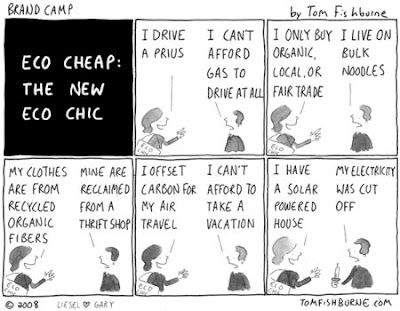
Tom Fishburne's recent post asks: "How will ethical brands fair when everyone is counting their pennies (particularly brands that command a premium)?" Mrs. Normal thinks she has the answer with the idea of "unshopping" explaining: "There’s no such thing as eco-shopping or ethical shopping. There’s just - not shopping. The catalogues and web sites urging you to buy ‘ethical’ things are still part of the problem – they’re in it to make money like everybody else." Spending more money just to impact the environment a little less may seem quite dated if we head into a new era of austerity.

Financier George Soros approaches the question from a different perspective. He's talking about the end of a 25-year "super-bubble" where, based on too much credit and too little regulation, the U.S. has lived far beyond its means. Soros does not think we should despair, however. He thinks that consumption can be replaced as the motor of the economy with a new motor aimed at combating global warming.

His thoughts: "I think we all have to consume less. We will consume less because we will have to. And rather than being unemployed, let's keep employment up. We'd use it for dealing with global warming. That, I think, is the way that this could work in the right way."

It's certainly a neat idea--adjusting to a new era of less consumption by addressing one of the damaging consequences of over consumption. But, I guess my question is this: Is the doom-laden opinion of late simply an over-reaction triggered by the deluge of calamitous financial news? Are attitudes about consumption really going to change all that much or are people just going to tighten their belts for only as long as they have to?

* Title Quote from Chitty-Chitty Bang Bang when the car nearly gets sold to the mean scrap man on his horse.

Wednesday, October 8, 2008

The financial crisis as told through football

First, there was Uncle Sam grabbing Ronaldo's shirt. Now, West Ham (another team in the English Premier League) who had already lost their shirt sponsorship when tour operator, XL Holidays went into administration are in even worse trouble. The Icelandic government took control of Landsbanki on Tuesday to prevent it collapsing and sacked the bank's board. That included Bjorgolfur Gudmundsson who was the chairman of the bank as well as chairman, major shareholder and primary source of funds for West Ham. (Iceland itself is now on the brink of bankruptcy.)

Overall, English clubs have about $3 billion in debt which is not a great position to be in especially since the holders of the debt are themselves in serious difficulty. Football Association chairman Lord Triesman believes the global credit crisis poses a "terrible danger" to clubs dealing with spiralling debts. He told BBC Sport: "They're beginning to see the edge of the hurricane - the art is to get out of the path of it."

Meanwhile, Leicester City (sponsored by Topps Tiles) are still top of Division One. As a long suffering fan , I had to share that.

Tuesday, October 7, 2008

Financial crisis: What can you say (as a marketer)?

Tricky. How to walk through a minefield in the middle of a hurricane? What should financial marketers be doing and saying right now?

Not to pick on anyone in particular but let's take a look at Bank of America. I saw one of its new print ads yesterday. Its headline: "A new opportunity to bank with confidence, security and a higher interest rate." with an offer of a 0.25% interest bonus for new deposits over $10,000. It doesn't have the humor of the best-in-class WAMU/Chase ad and it's probably going to annoy current customers who won't get the higher rate. But it seems about right in terms of acknowledging the crisis and its customers needs for reassurance without dwelling on it.

On the other hand, as a BofA customer, I've not (to my knowledge) received any specific communication by mail, email or otherwise talking about what's going on. And the website is blissfully unchanged.

On the other, other hand BofA has just reached a settlement with 11 states that had sued Countrywide (which it acquired) over its predatory lending practices. This settlement puts it in a leadership position in dealing with the mortgage crisis and scores one in the "actions speak louder than words" column. Overall, not bad with some room for improvement.

Some thoughts from reading various articles and posts over the last couple of days:

1) It's not business as usual: Carrying on, ostrich-like, as if nothing has happened and nothing is happening is not the right approach. Trying to take advantage of the situation in a crass way, even worse. Every ad and piece of communication should be filtered through the lens of: Does this still make sense? Ron Shevlin takes one bank to task for its recent ad that carried the headline: "Confidence is good. Earning it is better." As he says: "You do not earn confidence by simply offering a good rate. This is true even in normal times. But what what makes this ad so insulting is that these are not normal times."

2) Customers want reassurance: Elizabeth Glagowski points out in Think Customers: The 1to1 Blog consumers that customers are feeling jittery and are hungry for information. As she says of her bank: "I will get 100 offers for credit cards or ID theft protection every month, but when I want to hear from it about if it's staying in business, I get nothing." It's, of course, very difficult to craft the right message--the last thing that customers need is a "everything is OK, trust us" approach. That will definitely get them worried. What they want is candor.

Charles Schwab seems to be doing quite well in striking the right tone and addressing its customers concerns. It takes advantage of the already-established rapport and connection of Charles Schwab (the man) with his customers with ads and website featuring open letters from the Chairman giving his perspective on market conditions.

3) Survival tactics in troubled times: Tom Peters lists 44 tactical rules for weathering the storm. They are general rules, sort of a pep list, but some are worth bearing in mind especially: K.I.S.S., hammer on the basics, way over communicate (with everyone) and transparency.

Links:
1) Ads That Soothe When Banks Are Failing: The New York Times

Deals and taglines for troubled times

Ad Age has put together a one-page summary of the deals, taglines and strategies that a selected group of marketers have put together to keep their business in these troubled times.

Most of the companies on the list have found ways to focus on value, sometimes weaving it into an overall message: "Warm hearts without stretching budgets" (Kraft Singles), sometimes more bluntly: "Guaranteed low prices. Now even lower" (The Home Depot). Perhaps Red Lobster has the best cure for the financial blues with a promotion for: "Endless shrimp." Perhaps not.

The list also includes a media spending summary for the first half of 2008 vs. the same period last year and it's interesting to see who's increasing spending (Wal-Mart, Chili's and Dunkin' Donuts) vs. who's been cutting back (The Home Depot).

Saturday, October 4, 2008

Financial Crisis: Restoring trust and confidence

Rob Findlay has a good post at The Bank Channel titled: After the storm must come trust where he proposes a six-point "Trust & Confidence offensive" to restore customer confidence. As he says: "You need to use and hear words like trust, safe, confident, and not hear words like switching, complaint, cash and mattress. Taking care of your customers is crucial."

Wednesday, October 1, 2008

Why this is a great WaMu ad under the circumstances

The copy reads: “WaMu has a bright new future, thanks to the stability of JPMorgan Chase (and their nearly trillion dollars in customer deposits). But Chase brings more than money to the party: together we have 14,300 ATMs and 5,400 branches nationwide, a quarter of a million employees, and the confidence of banking with over 100 million other customers.”

Given the current climate, this ad seems like the perfect way to “sell” the unexpected union between Chase and WaMu to WaMu customers, combining a message of security and convenience. This kind of approach may have a “sell-by” date after which WaMu customers might start thinking again about all the reasons they used to like their bank and wouldn’t want to be part of Chase. But, at this particular moment of financial uncertainty, it really works and is executed in a way that's completely "on-brand" for WaMu. (It's also helpful that Chase's trillion dollars are more than the bailout's 700 billion, a number that everyone is now all too familiar with.)

(via: The Financial Brand)

 
Blog Directory - Blogged