It's only Wednesday but I think we have already have a MOTW winner (and the story will be completely irrelevant by Friday anyway).
OK. Here's the story as far as I can piece it together (with translations for the uninitiated).
Lady Gaga's Little Monsters (fans) had succeeded in making #alejandro (a hashtag reference to one of her songs) a Twitter trending topic. Then Twitter decided to remove this hashtag. Why? Who knows.
Anyway, that sent the Little Monsters into a frenzy so they came up with another tag, #monsterrevenge to replace #alejandro and managed to get that new hashtag to be the #1 trending topic for a while. And, very importantly, trending higher than the hated (by them) Justin Bieber.
Tweets from the storm:
RT @BeccaGaga: night #LITTLEMONSTER s and twitterers ;) #MonsterRevenge won in the end!!
RT @carolmbat: WE RULE TWITTER! #Alejandro and #MonsterRevenge IN THE SAME DAY! YAAAAAY
RT @GagaCity: there's nothing more frightening than an army of pissed-off Lady Gaga fans #monsterrevenge
@MonsterChelsko: Twitter must be in hiding after killing off #Alejandro because they're afraid of our #MonsterRevenge ;D
And the all important one from the very media savvy Lady Gaga herself:
RT @ladygaga: #monsterrevenge too?? You're on fire today! I'm really gonna kick some ass in rehearsal now, got u in my heart through every move + breath
Now that's loyalty marketing for you.
Tuesday, April 27, 2010
Meme of the week: #monsterrevenge


Wednesday, January 27, 2010
What's going to be the next ethnic food hit?
 I missed the Winter Fancy Food Show in San Francisco this year. As 1,300 exhibitors from 32 countries showed and sampled their 80,000 products to 17,000 attendees, I was off to India. But Andy Whitman of 2x Consumer Products was there and produced his usual excellent summary of emerging trends.
What he saw amid the sea of chocolates, olives and cheeses was the possible emergence of lesser know ethnic foods to take the place of those like Japanese, Thai and Indian that have become more mainstream.
As he says: "The 'big three of ethnic foods' Italian, Mexican and Chinese – are so broadly consumed they’re really American food. The next most popular ethnic foods – including Japanese, Thai, Indian, Mediterranean and others – have already begun their 'mainstreamization' as a result of the plethora of authentic restaurants, Americanized offerings at casual dining like TGI Friday’s and Cheesecake Factory and of brands like Thai Kitchen and Marrakesh Express companies. With ethnic foods consistently other grocery products and maintaining growth in softer economic times ... lesser known ethnic foods from
of the globe are likely to emerge as 'the next wave'."
I think that's right. Part of the attraction for ethnic foods is that they are not everyday, not the type of thing you'd find in TGIF. There's a fashion element. Once your mother-in-law is wearing Uggs, it's time to stop wearing them (if it ever was).
Which contrivance brings us to just one of the candidates that Andy discovered at the show that may benefit from this search for the new ethnic foods. It's Mother in Law's Kimchi and apparently it's really good (a thumbs-up from the New York Times as well). The product is based on an original recipe from founder Lauren Chun's inlaws' Jang Mo Gip restaurant in Garden Grove, CA.
Other products identified by Andy also representing this new trend: Afghan Bolani and Fava Dip, based on a popular Egyptian dish.
Monday, May 11, 2009
Why do popular brands have such incredible staying power?
 Photo: atomicjeep (flickr)
Why is Tide so popular? Why is Heinz Ketchup still so popular in Pittsburgh? These questions, posed by Tyler Cowan on his Marginal Revolution blog, generated lots of interesting answers. I'll give you a summary in a minute but, first, the set-up.
Tide: It has a 44% share of the market and has held this market lead for decades even though it's more expensive than its competitors. Heinz: Launched in Pittsburgh in 1876 still has a better share in its hometown than in other cities. Tide and Heinz are just two examples. There are countless other longtime packaged goods market leaders and many other brands that have their best share in their home market* Why?
The theories that don’t work (at least not completely)
1) Product superiority: Tide works better, smells fantastic. Heinz is thicker, has a secret formula. No doubt that actual product quality plays a role but it doesn't explain why Heinz does better in Pittsburgh than anywhere else. And is it possible that Tide has been market leader all these years just by keeping product advantage over the competition?
2) Buy Local: Local people support local brands and local brands support the local economy. Seems logical for Heinz which has always been active in a fiercely loyal community but it doesn’t explain why, for example, Milwaukee’s Miller Beer has always done so well in Chicago. (But maybe that’s, in part, because it’s at least not St Louis’ Anheuser-Busch.)
Consumer-based theories
3) Mother knows best/habit: Several people talked about how the purchase of Tide/ Heinz is a tradition passed down in the family from generation to generation. Buying products with this heritage is both reassuring and familiar and gives you one less thing to think about when you are at the store.
4) Conditioning: After a while, people get used to certain aspects of products that may be technically quite similar. The taste of Heinz, the smell of Tide, the thickness, the packaging, the color. Try to get a diehard Diet Coke drinker to drink a Diet Pepsi (or vice versa). We’re all sort of like rats in the end.
5) Decision set/habit: Another variation of mother knows best. “Jeff G” who worked on a competitive brand to Tide, said that his company’s purchase decision research had shown that the first decision was “are you a Tide customer or not” Then, if not, you typically believe ‘All are the same’/ ‘I am Poor’ and your decision is based on price.
Competition-based theories
Then there were a set of theories that spoke to the power and advantage that a leader enjoys and can leverage in what is less than a perfectly competitive market:
6) Distribution advantages: Market leaders become category captains influencing what gets on the shelf and benefit from being able to justify more skus than anyone else. That “wall of orange” tends to crowd out everyone else at the point of purchase.
8) Fixed costs: Many of the costs of doing business in the CPG are fixed. Trade ads, for example. These can be absorbed with much less P&L impact by Tide than by the smaller players giving Tide a continuing margin advantage that it can either bank or spend on other marketing activities.
9) Brand equity/Sunk marketing costs: One place that they can spend those extra dollars is building up brand equity and connecting the brand to the important category drivers. Years of marketing spending build a strong brand foundation that's difficult to undermine.
10) Competitors are followers: In large part, competitors have not tried or been able to disrupt the category by coming up with big enough product innovations. One comment notes that, in detergents, only All has made a determined effort to take on P&G with breakthrough ideas.
Another interesting point is that this phenomenon is more pronounced in CPG products than in other categories. Being one-time leaders hasn’t helped retailers like A&P, Sears and Kmart. And, in the online space, being a one-time leader like CompuServe or AOL is more of a disadvantage.
Perhaps that's because CPG products differentiate more by their identity than by physical factors? If consumers can’t differentiate between products (at least not in blind tests), they need to rely on other factors to make their decisions.
So, can anything dislodge a package goods market leader? There were some thoughts on that as well:
1) The leader falls asleep at the wheel: The #1 brand is well protected from the competition for the reasons described above. And usually such brands have time to recover even if they make a series of missteps (New Coke?). But protracted neglect and no marketing investment may give challenger brands at least an opportunity.
2) Big market changes happen that disrupt the model: Typically, the pace of change in CPG is relatively slow compared to other categories (like consumer electronics) and there's less chance of a leader being caught completely unawares of new trends. Changing demographics (e.g. the rising influence of the Hispanic consumer) can have an effect and certainly creates opportunities for brands that previously were considered niche to become more mainstream (e.g. Nescafe Clasico).
3) Category reinvention: What business is Heinz in? Just ketchup? All condiments? BBQ vs. other meal choices? In the end, the biggest danger for market leaders like Heinz may come from the declining relevance of their categories. If ketchup becomes a less important part of the American dining experience, Heinz will suffer even it stays the leader. And, today, all packaged goods are suffering from the center-aisle problem with fresh alternatives on the perimeter gaining ground.
Bottom line: If you are a #1 brand in a CPG category, congratulations. You are in a strong competitive position for all sorts of reasons. Unfortunately, you've still got plenty to worry about. Retailers are scaling back shelf space for packaged goods to give more room to fresh products and, at the same time, they are launching own-label brands that are becoming more and more of a threat. That's, in the end, is where the real battle is these days.
* Current share in markets of origin for brands launched back in the late 1800s and early 1900s is 12 percentage points higher than their national share. Source: Brand history, geography and the persistence of brand shares by Bart J. Bronnenberg Tilburg University, Sanjay K. Dhar University of Chicago Booth School of Business, Jean-Pierre H. Dubé, University of Chicago Booth School of Business.
Wednesday, April 22, 2009
Googlefication update
Here's just one day's worth of Google news, with a little melodrama thrown in:
1) Google kills home pages: "A company's corporate home page is Google.com," says Dell’s VP of Communities and Conversations, Bob Pearson. By which he means that the way that most people look for a company is by typing its name into Google rather than trying to guess the url. Len Kendall explores the implications in this post, pointing out companies need to become active participants in providing content that makes to the search pages. Or others will be there instead.
2) Google kills newspapers: Now you can see your news in a visual timeline: Screen grab from: brandflakesforbreakfast
3) I'd kill to be on Google: No killing required. Just a little bit of work and you can make it onto the front page. A Google profile:"allows you to control how you appear on Google and tell others a bit more about who you are." People are arguing whether this will or will not kill Facebook.
Thursday, October 16, 2008
5 Reasons why now is the perfect time to buy a Hummer
There's no point, in times like these, just following the crowd. You've got to be one step ahead of everyone else and, Gretsky-like, go to where the puck is going. So, while everyone else is thinking about dumping their gas-guzzling SUV monsters and signing up on the waiting list for a Volt or a bus pass, you should be heading to your nearest Hummer dealership. Because:
1) Gas prices are tumbling: With the economy heading for the rocks, gas prices are in freefall. Back in July the U.S. national average hit a record of $4.11. Now prices are under $3.50 and, at this rate, they will be under $3.00 very soon and heading back to $2.00 not long after that. (See chart)
2) There's tumbleweed in the showrooms: A friend of mine visited a Land Rover dealership a few weeks ago on a Saturday morning, normally a peak time. In the three hours he was there buying his vehicle not one single other person even poked their head in the door. That may not last for much longer.
3) Of course, great deals: Edmunds.com, the automotive site, says that incentives for large trucks and SUVs hit a record $5,953 per unit in August. These models were always the most profitable for the automakers so there's more room for them to go deep with their discounts.
4) Peace of mind in these hard times: Why keep your money in the stock market? You're only going to give yourself an ulcer watching the market go up 900 points one day and down 800 the next. You may as well cash in. Plus, if things get really tough and marauding crowds are roaming the streets, a Hummer will give you some necessary protection.
5) Something to tell your grandkids about: In 30 years time, when your kids have had kids and your role is to buy candy and otherwise undermine all the rules in the house, you can sit your grandkids on your knee and show them faded, color pictures of times of yore when people drove round in tank-like vehicles just because they could. Your grandkids will be open-eyed in amazement and it'll give them something to tell their virtual school friends.
Links:
1) Incentives luring buyers back to pickups, SUVs: MSNBC
Monday, October 13, 2008
The Frugal Economy: "Times are hard, you know*"
Is there anyone out there who thinks we're not heading for an all-time doozy of a recession? You don't? Well then, read this. The rest of us will wait. (Time passes.) OK, now we're all back and on the same page, let's talk about the recession will affect consumption.
Specifically, do you think that the recession will lead to a New Age of Frugality and a different attitude to buying? BusinessWeek says that Americans' charge-it culture is getting an overdue reality check and that thrift and penny-pinching are already taking hold. The kind of thing to expect in the future perhaps evidenced in a recent Gizmodo post titled: Zero-Cost Gadget Upgrades For the Next Great Depression which listed the best hacks to "breathe life" into old hardware.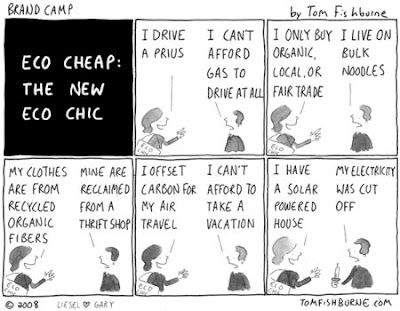 Even better than buying the right thing is buying nothing at all
Tom Fishburne's recent post asks: "How will ethical brands fair when everyone is counting their pennies (particularly brands that command a premium)?" Mrs. Normal thinks she has the answer with the idea of "unshopping" explaining: "There’s no such thing as eco-shopping or ethical shopping. There’s just - not shopping. The catalogues and web sites urging you to buy ‘ethical’ things are still part of the problem – they’re in it to make money like everybody else." Spending more money just to impact the environment a little less may seem quite dated if we head into a new era of austerity.
Financier George Soros approaches the question from a different perspective. He's talking about the end of a 25-year "super-bubble" where, based on too much credit and too little regulation, the U.S. has lived far beyond its means. Soros does not think we should despair, however. He thinks that consumption can be replaced as the motor of the economy with a new motor aimed at combating global warming.
His thoughts: "I think we all have to consume less. We will consume less because we will have to. And rather than being unemployed, let's keep employment up. We'd use it for dealing with global warming. That, I think, is the way that this could work in the right way."
It's certainly a neat idea--adjusting to a new era of less consumption by addressing one of the damaging consequences of over consumption. But, I guess my question is this: Is the doom-laden opinion of late simply an over-reaction triggered by the deluge of calamitous financial news? Are attitudes about consumption really going to change all that much or are people just going to tighten their belts for only as long as they have to?
* Title Quote from Chitty-Chitty Bang Bang when the car nearly gets sold to the mean scrap man on his horse.
Tuesday, July 8, 2008
The Day You've Been Waiting For...
 Some might say that the timing is a little off what with Starbucks announcing the closure of 600 stores last week. But hope springs eternal and now there's a new coffee shop just down the road for me to visit. Good luck to you intrepid entrepreneurs!
P.S. Don't you hate that when you run out of space when you're writing down an important message on a Pepsi poster
Wednesday, June 11, 2008
Economic blues beat out green concerns
Is concern for the environment a luxury we can't afford at the moment? With economic conditions deteriorating, house prices collapsing and the price of gas and food going through the roof, our priorities have shifted.
Landor's just-published 2008 ImagePower® Green Brands Survey shows that energy and economic issues having taken precedent in these challenging times. That's despite most people thinking that the environment is in worse shape than it was five years ago.
Also changing is what people think is the most pressing environmental concern. In 2007, most consumers were concerned about global warming. This year’s survey shows that energy and resource issues have increased in importance.
The survey also asked people to rank their greenest brands. This year's U.S. top 10:
1. Whole Foods
2. Burt's Bees
3. Trader Joe's
4. Tom's of Maine
5. Toyota
6. Seventh Generation
T7. General Electric
T7. Honda
9. Whirlpool
10. Aveda
Once again, body care and grocery are rated as the “greenest” product categories. Travel and energy were rated as least green.
Links:
1) Environment a Fair-weather Priority for Consumers: Landor.com
Tuesday, June 3, 2008
Fiji Water's green offensive
My very first blog, almost one year ago, was about the challenges faced by Fiji Water as it emerged as the poster child for all that environmental activists believe to be wrong with the bottled water industry. Its super-badge status, extreme price premium and the fact that it's shipped half way around the world from a place where many locals don't have safe drinking water of their own all contributed to this unsought position.
Fast forward to now and, whatever your opinion about bottled water, you've got to be impressed with the sheer commitment and determination that the company has shown to protect its business. Treating the press and blog commentary last year as an early warning signal, the company has geared up to meet its critics head on. And rather than play defense, Fiji Water is on the counter-attack presenting itself as an eco-friendly green company that's actually carbon negative.
It's also taken a whole series of actions to reinforce its green credentials: changed its shipping routes, made commitments to further reduce emissions, supported laws that would include water bottles in deposit-driven recycling plans (which most beverage companies oppose) and, with all that, launched FijiGreen.com and a new "Every Drop is Green" campaign to get the message out.
None of this will persuade its fiercest critics--but they don't buy bottled water. What it's more likely to do is turn back or at least weaken their critical assault and protect sales (which have, so far, stayed healthy). As Rob Six, Fiji Water's vice president for corporate communications, told Rob Walker in his New York Times magazine article: "Any time you see negative stories in the press, you have to figure out how to respond." In this case, all guns blazing.
Links:
1) Water Proof: Rob Walker (New York Times Magazine)
2) Message in a Bottle: Charles Fishman (Fast Company)
3) Trouble in Paradise: Brand Mix
4) Green water: Brand Mix
5) More water woes: Brand Mix
6) And more on water too: Brand Mix
Sunday, June 1, 2008
Whole Foods losing in the supermarket shuffle?
If the changing shopping habits from one family living in Marin, CA were, in any way representative of families in general, Whole Foods would have cause to worry. This table shows our response to the steep rise in grocery prices. Back in those happy and cheap 2006 days, half of our grocery trips were to either Whole Foods or an upscale grocer (Andronico's). Now, those two retailers account for just one of every ten trips--Whole Foods hanging on by a thread because, according to my wife, it has the best fish.
The winners are: Safeway and Trader Joe's--Safeway being the best option for staples (but see note below) and Trader Joe's providing the variety and food adventure that we used to get from Whole Foods but providing it much less expensively.
Over in the UK, grocers are starting to respond to rising prices by highlighting ways to shop affordably. Both Sainsbury's and M&S have launched signposting campaigns ("Feed your family for a fiver" and "Dine in for two for £10") to help customers stretch their budget.
This particular campaign wouldn't work for Whole Foods and it's never going to be the cheap choice. But if it wants to stay on the list of grocery destinations, it may have to figure pretty quick its own variation on this theme.
Note: Being in the far reaches of the Wal-Mart empire, our nearest store is over 30 miles away and not a viable option (especially with the price of gas). If it were closer, it would probably have taken some if not most of the Safeway visits.
Links:
1) The tide turns. Wal-Mart rises: Brand Mix
2) Why oil and shopping don't mix: The Store Blog
Friday, January 4, 2008
Meatball Sundae Thought #3: Blogs
In his new book, Meatball Sundae, Seth Godin describes how blogs have given power to the individual voice. "For the first time in history, the graffiti on the wall has more power than the official version from an organization," he writes.
But they can also help organizations get in better touch with their customers. As I write this, a big Pacific storm is raging outside and it's likely to either flood out or knock the power out of my small hometown, Fairfax. As I was looking for information about damage done or damage expected, I ran across this blog from the Fairfax town hall manager.
Nothing special, except that a) I have my flashlight at the ready as instructed and b) I've signed up as a subscriber and I'm much more likely to leave a comment and have a dialogue with the town than I ever would have been before.
Saturday, December 29, 2007
Meatball Sundae Thought #1: The consumer's voice
As I mentioned earlier, I have been invited to participate in Seth Godin's virtual book tour for Meatball Sundae. I just finished the book. It's a great read. Also thought-provoking, so I thought that I would share some of those provoked thoughts with you leading up to Seth's scheduled tour stop at this blog on January 16th.
So, thought #1 - you're damn right - the consumer's voice is LOUDER than it used to be. This is Trend #2 of 14 trends that Seth says are ushering in the fourth industrial revolution. A revolution that replaces mass marketing with new approaches that recognize that technology and competition "has led to a world where many people can get what they want, when they want it." And one of the things they want is respect.
Case in point - it's a lot more risky for hotel managers to insult their guests than it used to be. Back in the day, hotels could treat their guests badly and the worst that would typically happen is that guest wouldn't go back to the hotel and perhaps a few of their close friends would hear about it and they wouldn't go there either. But now there's TripAdvisor and many other places for people who've been done wrong to make loud their protest. Here's my tirade, for example, against the 3Peaks Resort and Beach Club where I stayed on my recent ski trip.
As Seth points out in the book, "the Web remembers forever" so my review is a permanent record of my experience and could still, potentially, be influencing people for years to come. It just isn't going to make financial sense to be rude anymore when any guest could be that person who will take the time to warn others of what they might expect.
Monday, November 26, 2007
Buying better, even if it means buying less
Could the long era of low prices über alles be starting to wane?
This has been the year of product recalls, mostly toys, mostly Chinese-made. The drive to reduce costs to keep prices low has led contract manufacturers to cut corners and push out substandard and sometimes dangerous product.
American companies have responded by refocusing on quality assurance and making sure that their suppliers stick to the specifications. That, by itself, will have some upward impact on prices but the larger, more consequential effect will be if consumers start trading quantity for quality.
Early results from Black Friday including the crushing crowds at the many 12:01am store openings offering early bird discounts suggest perhaps not, but let's give it some time.
Friday, November 16, 2007
Global warming is hot
A story about a factory in Arizona planning to make some upgrades and modifications - not your typical front page of the New York Times above-the-fold material. But, when the angle is green, all things are possible.
Frito-Lay has announced that is going to create an eco-friendly chip by taking its Casa Grande plant in Arizona off the power grid, running it on renewable fuels and recycled water. It's only one plant and more and less an experiment for PepsiCo but it's a good example of how everyone is starting to get in the game.
The article quotes Andy Walker from the National Renewable Energy Laboratory saying that his phone is now ringing off the hook with companies asking for his help where, only a few years ago, no-one was interested.
Inevitably, toe in the water initiatives like the Casa Grande plant tempt companies to exaggerate their green credentials. But it's important that they don't get ahead of themselves in terms of what they say vs. what they've actually done. Consumers and advocacy groups are in a state of high alert looking for any suspicious and unwarranted green credentialing.
On the other hand, this particular initiative has given the company a huge product brand opportunity because its SunChips products are made in the plant. These will now be made using solar energy, just a perfect connection and one of the still relatively few examples where the way that the product is made is going to help the way it's sold.
Going forward, the stakes in this game are only going to get higher. I expect that natural food companies, for example, will soon find that it's not enough for them to make products that are healthy to eat. They will need to show that they are healthy for the environment as well - all the way through the supply chain.
Tuesday, November 13, 2007
Nothing to love at Levitz
 I remember when I first arrived in the U.S., some 20 years ago, driving all the way from Santa Barbara to Oxnard, an 80 mile round trip, just to go to a Levitz store. And being absolutely appalled by the furniture which I remember as being almost uniformly beige.
Having gone all that way I had to buy something, so I bought a foam chair that folded-out into a very narrow and spongy mattress. I can't remember how much it cost. Hopefully not much more than $20. I rarely sat in the chair and never used it to sleep on but I did keep it for years and years, in fact until I got married when my wife cleaned house of this and other relics.
So, it's surprising for me to hear that Levitz has only just now filed for bankruptcy. I would have thought they were long gone. Maybe the furniture got better over the years (I wouldn't know since I never went back and the web site picture above suggests not.) or maybe there was just enough of a market for the spongy, beige and ugly for them to limp along until now.
Wednesday, November 7, 2007
Monday, November 5, 2007
Zippo not so zippy
More on the smoking front....
According to The San Francisco Examiner, Zippo is reacting to anti-smoking legislation by diversifying its business with the goal of making 50% of its products non-smoking items by 2010.
Sounds like it caught them by surprise.
Cellphones, the cigarettes of the 21st century?
I've been watching the AMC series "Mad Men" (great show, by the way) and it reminds me that, not so long ago, there was no escape from cigarette smoke. Everywhere, all the time.
Now that public smoking has been banished to windy corners of office buidings, cellphones have emerged as the "don't care about anyone else" tool of choice. A New York Times article quoted James Katz, director of the Center of Mobile Communication Studies at Rutgers University as saying: " If anything characterizes the 21st century, it's our inability to restrain ourselves for the benefit of other people."
And the backlash has already started. As often is the case, the backlash pioneers have resorted to extreme (and illegal) measures by using cellphone jammers that shut down cellphones within a certain range. This particular approach is unlikely to go mainstream but these pioneers may represent just the first wave from which a second and more profound wave will sometime emerge.
Tuesday, October 30, 2007
More water woes
Imagine, for a minute, that you are the brand manager for Dasani and you wake up one day all full of vim and vigor and ready to enthusiastically embrace another day. Then, before you've even had time to dress, one of your colleagues forwards you this lead story on Yahoo! News rating your product as one of the world's worst (alongside a sleeping product for children).
Worse still the story used this AP/File Photo as the illustration.
No-one would like to see their brand featured like this but it must be all the more galling when you've thought of yourself as on the side of the angels. It's one thing to take the heat when you're marketing cigarettes or even sugary cereals (Kellogg's was also on the list) - you probably get used to it and build up some resistance. But bottled water marketers have faced a drastic reverse in their public reputation (see this earlier post and this one) and must still be wondering what's hit them.
Monday, August 20, 2007
Green water
More on the continuing challenges for bottled water to square its images of mountains and lakes with its impact on the environment. Even companies that are trying to stay ahead of the game and are addressing the issue of their carbon footprint are getting slammed.