skip to main |
skip to sidebar
Lululemon has ridden the wave of yoga's popularity with great success, selling high end yoga clothes and promoting healthy living. So deciding to associate with a philosophy that's the antithesis of what yoga is all about seems a little odd, to say the least.
As reported on NPR, the company's new shopping bags feature the question: "Who is John Galt?". And who is John Galt? He's the protagonist of Ayn Rand's novel Atlas Shrugged where she laid out her Objectivist philosophy, including the idea that selfishness is a virtue, a very un-yoga-like position.
Why this seeming act of self-destruction? Lululemon's own post on the subject explains that Chip Wilson, the company's founder, read Atlas Shrugged when he was 18 and was really inspired by it. So this could be a simple story about another ego-charged CEO running amok. But it's a bit more complicated than that.
The company was, in fact, founded with the mission to "elevate the world from mediocrity to greatness," an idea straight out of the Rand book. And its culture reflects many of her ideals. If you look at Lululemon's brand manifesto, you can see that it's a sampling of ideas and philosophies, some yoga-compatible ("The pursuit of happiness is the source of all unhappiness") and some more Rand-like ("Successful people replace the words 'wish,' 'should' and 'try' with 'I WILL.'").
As long as you don't delve too deeply, the company's mix and match of ideas kind of holds together and the company has clearly thrived despite its ideological impurity. The problem with the John Galt bags is that they shine a bright light at just one of the sources of inspiration and a very polarizing one at that. Now everyone who buys from the store will be carrying out a political statement as well as some expensive clothes.
Let's see what the impact will actually be. Maybe nothing. Whole Foods didn't suffer any lasting damage when its CEO did something similar. But the bags have caused quite a stir in some quarters of the yoga community with many promising never to buy anything from the store ever again.
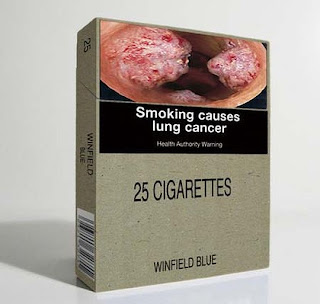
Australia has become the first country in the world to ban the branding of cigarette packages. From next July, all packs will look like the one in the picture--they will be a deliberately unappealing olive green color, the brand of the manufacturer will be printed in a tiny, generic font (i.e. no trademarks) and the only images will be graphic health warnings. Thus the Australians are setting up an interesting, real world packaging test. What will happen when the new, generic packaging hits the shelves?
The one thing that the government and the cigarette manufacturers agree on is that the impact will be significant. Given previous bans on advertising, sponsorships and other forms of marketing communication, the pack is the last bastion of branding activity. Health Minister Nicola Roxon says that she believes the new law will give Australia the best chance of having the lowest smoking rate in the world.
Manufacturers, for their part, have threatened legal action on the basis that the new rules restrict their trademark and intellectual property rights. The British American Tobacco Australia (BATA) issued a statement which said: "The result of BATA's legal challenges could force Health Minister Nicola Roxon to pay tobacco companies billions of dollars for the
removal of trademarks, brands and pack space."
Assuming these legal challenges fail and the law goes into effect, what will happen? Will demand go down as expected? Not according to the cigarette manufacturers. They are actually predicting that demand will go up because they will be forced to compete on price. David Crow, CEO of BATA, says that's what his company intends to do: "We will obviously focus on pricing given it's the only thing really left to differentiate brands."
So could the unintended consequence of the legislation be that smoking actually increases because the market is flooded with cheap cigarettes? The cigarette manufacturers have an obvious interest in coming up with worst-case scenarios but this one does seem to have some merit.