Saturday, October 30, 2010

SOTB: Halloween Edition

Carving credited to Ray Villafane, an artist in Michigan
It's Halloween, all scary, orange and sugary:

1) Zombie Reports via @LenKendall
First off, it's important to keep tabs on where all the zombies are. This useful site keeps you up-to-date on sightings, places under attack and deaths. Plan accordingly.

2) The Sears Zombie site


One more sighting--zombies on the prowl in Sears. If you are already a Zombie, click on this link that translates everything into Zombian for you. The "Fitness for Zombies" video will also be of interest because, as it points out, "It's not uncommon to feel a little stiff after becoming undead."

3) 'Stranger Danger' and the Decline of Halloween: Wall Street Journal
Of course, we all know that zombies aren't the problem--it's our neighbors and all the horrible things that they're planning to do to our trick-or-treating kids that we need to worry about. Here's a remarkable fact from the WSJ: "No child has ever been killed by poisoned candy. Ever." Lenore Skenazy, author of Free Range Kids, uses the pervasive myth of poisoned candy as a jumping-off point to explore other ways kids childhoods are being taken from them by fearful parents.

4) A Not So Scary Halloween: The Keyhole
Not scary for retailers perhaps since they are benefiting from more consumer confidence and the fact that Halloween falls on a Sunday this year. But scary enough when you read that Jersey Shore characters are the #1 costume choice of the year. What a situation!

5) Ridiculously big pumpkins and what you can do with them
First of all, if you ever wondered about the science of growing really huge pumpkins, Wired Science has all the answers here. The big 'uns can put on 50 lbs a day and The New York Botanical Garden, is predicting that a 2,000-pound pumpkin could be grown soon. (The record is just a measly 1,800 lbs right now.) But, more important, is to know what do you do with such a big pumpkin once you've grown it. Here's one idea (via @GeorgeKrautzel):


6) Beards, Wigs and Panda Heads: It’s Giants Baseball: The New York Times

Great Pumpkin Sighting by chucknado
Finally, I can't let this week pass without some mention of the San Francisco Giants who ARE IN THE WORLD SERIES. The team's orange and black colors are perfect for this Halloween time of year and the eccentric personalities of the team are a perfect fit for the city. They should be in the World Series every year, I think. Go Giants! Fear the Beard!

That's it! Back soon with more stories from the world of brand strategy. More thoughts and comments also available on Twitter (@martinjbishop).

PS: This new editor on Blogger is driving me crazy--it keeps on changing all my line spacing. Maybe time for a change?

Monday, October 25, 2010

Brand debate #1: A question of focus

Today finds two of our Xtranormal colleagues having a lively debate about branding. Let's tune in to see what they're talking about this morning:


Note: Hopefully, neither of these two Xtranormal characters looks like, talks like or thinks exactly like any particular real person. At the same time, their opinions should sound vaguely familiar.

Saturday, October 23, 2010

SOTB: Failure, Fakery, Shouting and Swearing edition

A mixed bag of stuff this week from branding problems to the effective use of swearing:

1) 41 Causes Of Brand Failure: Branding Strategy Insider
This post from Branding Strategy Insider summarizes their long-running series called the 40 Most Common Brand Problems (now at 41). These are the most common and notorious problems they've encountered.

2) China: The Land Where Fake Brands Reign Supreme: Weird Asia News


Not on the 41 causes of brand failure list, but still a big problem is China, are fake brands. Taking things to a whole new level, the city of Nanjing, east of Shanghai, is soon to open a new shopping center dedicated to some 58 fake brands. There'll be the triple arches of McDnoald’s, a Starbucks lookalike Bucksstar Coffee, Panosaonic electronic products, Gillehe shaving supplies, Pmua sneakers, etc etc. 

3) The animated Sir Ken Robinson: Presentation Zen


Sir Kenneth Robinson explores the failure of education. in this RSA animation adapted from a much longer presentation given at the Royal Society of the Arts in London. It's interesting both for the content of the speech itself and the animation. Garr Reynolds adds another layer of interest here by exploring the persuasive presentation qualities of both the animation and the speech.

4) The Persuasive Power of Swearing: PsyBlog
Not something that Sir Kenneth would resort to, but swearing is persuasive, apparently. Researchers found speeches which included the use of "damn" at the beginning or end of a speech were more influential than ones that didn't. Maybe I should start dropping the "f" bomb in some of my presentations. I think it could work out great.

5) When in doubt, shout – why shaking someone’s beliefs turns them into stronger advocates: Discover

More from the wacky world of cognitive dissonance--when someone's beliefs are shaken, they become even stronger advocates for those beliefs. Could this finding mean that, the current louder and louder volume from people with entrenched positions is a harbinger of a future world of peace and harmony?

6) Superheroes - GEICO commercial


This latest Geico spot was produced entirely in XtraNormal. Inspired by this spot, I am going to post my first XtraNormal spot on branding next week. Stay tuned.

That's it! Back soon with more stories from the world of brand strategy. More thoughts and comments also available on Twitter (@martinjbishop).

Wednesday, October 20, 2010

Brands in the News: Nissan and Silly Bandz

Two brands--one dead in the water hoping to catch a wave, the other on the crest of a wave, heading for an inevitable wipe-out.

1) Nissan Gets a Marketing Makeover With Leaf: AdvertisingAge

Nissan LEAF by cliff1066 on Flickr
Nissan is a brand that has lost energy and momentum and hasn't found a way to get it back. It has some good cars in its portfolio, it has pretty good quality ratings but it's stuck. It's become a generic Japanese brand, undifferentiated and unloved. "At our core," said Carlos Tavares, Nissan's leader for the Americas, "we didn't know what we stood for." The brand needs a makeover, some emergency defribillation to bring it back to life. Fittingly, the company has decided to put most of its eggs in the all-electric, zero-emission Leaf EV basket. For brands like Nissan, stuck in neutral, it's a huge challenge to turn around brand perceptions--great products and service may not be enough. Nissan is hoping is that the Leaf will provide enough spark to get things moving again

2) Silly Bandz

Silly Bandz by HarmonicMama on Flickr
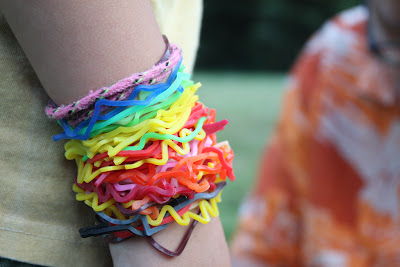
If you have a kid in elementary school like I do, you know all about Silly Bandz, bracelets that come in dozens of different shapes from dolphins to Captain America. They're worn, they're traded, they're everywhere. They've become so popular that some schools have started to ban them. Robert Croak started  it all after getting the idea after seeing a cute, shaped rubber band at a product show in China. Now his company is cranking out millions of these bandz and finding it difficult to keep up with demand.

These are the kind of fads that hit from time to time. No one sees them coming, they are only easy to understand after the fact. They spark lots of imitators but no-one can ever replicate the initial success. The dilemma for people like Mr. Croak is what to do next. Whether killed off by school administrators or dying from lost interest, these bandz will not be around for very long. (We may already have seen the beginning of the end as the company has just released a Justin Bieber pack.) Can there be an encore? Can all energy be harnessed in any useful way or is it just like lightening--a huge explosion of energy and then nothing? Crocs never found the answer. Will Croak do any better?

Saturday, October 16, 2010

SOTB: The future's so bright edition

As the 33 Chilean miners made it out safe this week, it triggered a memory for me of a famous headline: "Earthquake in Chile. Not many dead," which apparently won a newspaper competition for the dullest headline ever. Dreadful as the experience was for these miners, especially in the days before they were found, their future seems much brighter.

1) Made in the Shade with Oakley real-time Chile miner marketing coup: Web Ink Now


Here was some good thinking. As an estimated one billion people tuned in to see the 33 Chilean miners get rescued, Oakley donated Radar model sunglasses with their black Iridium lenses to protect the miners eyes. Graceland also found a way to grab some of the limelight.

2) Glass Half Full-Montage: Jet Blue


The promise of a better traveling future from Jet Blue with some funny ads that point out some of the absurdities of air travel that we would never accept on the ground.   

3) Mom's on Facebook: Saturday Night Live


In the future, more of us will need the "Dammit, my mom's on Facebook filter." Like!

4) Smell Like A Monster: Sesame Street


In case you haven't seen this yet, the best Old Spice parody yet. Sadly, you're not a monster.

5) 106 things that are awesome: brandflakesforbreakfast

Perhaps in the 20% of their time devoted to "other" projects, some people at Google have assembled this reference document of 106 awesome Internet things. You'll have seen some of them but there's tons of good stuff here, all in one convenient place.

6)  Beautiful video-mapping show projected on Prague's 600-year-old medieval Astronomical Clock: Boing Boing

The 600 Years from the macula on Vimeo.
Google's doc does have some examples of video mapping but it doesn't have this show, projected on the medieval Astronomical Clock in the city's Old Town Square as part of a celebration for the 600th anniversary of the clock's construction. Fantastic.

That's it! Back soon with more stories from the world of brand strategy. More thoughts and comments also available on Twitter (@martinjbishop).

Wednesday, October 13, 2010

Brands in the News: Breakaway brands of 2010


The results of Landor's 2010 Breakaway Brands study are in and, as usual, there are some brands on the list that are no surprise (Facebook) and others that are a bit more scratch-your-heady (Clif Bar at #1?). Hayes Roth, Landor's CMO, provides a full report (here) on the brands that made the top 10.

As far as an overall evaluation, the list suggests that the brands that have done well are those that have managed to convey a return to simplicity and personal connections. As Hayes says
:
When the future appears uncertain, people tend to gravitate toward what’s truly important in life—the basics we believe will endure and sustain us. This year’s Top 10 Breakaway Brands met our fundamental needs while making our increasingly complex lives easier and more enjoyable. Through the worst of a global financial crisis when our wallets were thinner and our psyches fearful of superfluous spending, these brands found their way into our lives and earned our respect and loyalty.

Brands that help us spend quality time, make joyful memories with family and friends, and otherwise connect us to each other are prevalent on the 2010 list. Maintaining health and happiness took precedence over flashiness and fashion—these are brands that served us, versus helping us show off. We embraced brands that felt honest and authentic with recognizable, relevant personalities. We sought comfort, and these brands assisted us in that quest.
Note: The top breakaway brands are the ones that have grown the most in brand strength over the past three years, as measured by BrandAsset® Valuator.

Wednesday, October 6, 2010

Meme of the Week: The dueling Gap logos

The new Gap logo is not getting much love from the design community. As Advertising Age says: "Detractors have been picking apart the new look, with the most common sentiment being that it looks like something a child created using a clip-art gallery."

My job is not to join the debate but rather point you to the dueling tweets, one representing the new logo (@gaplogo) and one, the old logo (@oldgaplogo). (For all I know it may be the same person.) Twitter is perfect for this kind of show:


Best of @oldgaplogo:
  • (Profile) I have feelings, too. Jerks.
  • This is what happens when you take a company field trip to a screening of Helvetica. Damn you Gary Hustwit!
  • @ I think I'm worth at least a D-.
  • What I need right now is someone to go on YouTube and defend me in a video. Heavy eye-shadow is optional. Uncontrollable sobbing is a must.
Best of @oldgaplogo
  • Hey @ I hear Milt Glaser is on his way over with the ghost of Paul Rand to kick your ass.
  • Look at your new logo. Now back at me. Now back at your new logo. Sadly he is not me.
  • Help...i've been taken hostage. Everything is dark and I don't know where I am.
The Gap itself is staying out of it. No official press release and no comment about all this noise either.

Tuesday, October 5, 2010

Breaking news: Sun Chips committed to its compostable bag

This morning I reported on the apparent demise of Sun Chips ground-breaking 100% compostable packaging because of the incredible noisiness of the bags. It was widely reported that these bags were going to be taken off the market.

I received the following note from Sun Chips in reply:

"Not to worry our 100% compostable bag is not going away. We're committed to renewable packaging solutions and will continue to use 100% compostable packaging on specially-marked Original flavor SunChips® snacks. In the meantime we're busy working on the next-generation bag that addresses consumer feedback, so stay tuned."

Good news!

Brands in the News: POM Wonderful and Sun Chips

Two brands in the news today:

1) POM Wonderful vs the FTC


POM Wonderful has gone on the attack against the FTC. One week after being sued by the commission for making false health claims, POM's Lynda Resnick says that the official who made the accusation has gone "crazy" on the issue and is a "zealot." "The whole food industry is being bullied by the FTC and FDA," she went on to say. Coinciding with this lambasting, POM has launched a new ad campaign, replacing the one that the FTC had objected to. Although it does not repeat the same claims, it comes up with another provocative angle--the implication that POM will improve your sex life. The ad above features Sonja Kinski, daughter of Nastassja, as a naked Eve tempted by a serpent with a pomegranate replacing the apple. This battle looks set to go on for quite a while. Stay tuned.

2) Sun Chips grounds it "noisier-than-a-jetfighter-cockpit" bags

I have written before about how above-and-beyond Sun Chips had gone to reinforce its green credentials. From its name to its manufacturing process, Sun Chips has definitely been paying more than lip service to the environment. Unfortunately, its boldest initiative has crash-landed--its fully compostable packaging which looked like it had the potential to transform consumer packaging, is going to be pulled off the market. The problem: noise pollution. The new packaging was so incredibly loud, it had been compared to the noise inside the cockpit of a jet fighter and had inspired its own Facebook page.

Monday, October 4, 2010

Give me more choice. No, less choice. And never tell me what to do!

Continuing to find some interesting articles and posts about consumer choice and consumer behavior:

1) Well, it must be really good: Indexed

In my last post: Should brands tell the truth?, I referenced research that showed wine preference is more influenced by how expensive people think it is than what was actually in the bottle--the exact point made on this Indexed card.

2) What We're Following in Consumer Behavior: HBR
Jack Brehm, a psychologist, coined the term "reactance" to describe how people respond to a perceived threat to their independence. Recent research shows this consumer trait has all sorts of affects on behavior. For example:

  • If people have an opinion about something, an expert telling them something different is not going to help, in fact it will only get them to dig in their feet.
  • If you tell people they are brand conscious, they will react by choosing things that aren't branded.
  • If you confine people in tight spaces, they'll respond with independence-asserting behavior--researchers showed that shoppers will increase the variety of things they buy when they're shopping in crowded aisles of grocery stores.
3) A Better Choosing Experience: strategy+business
Given our ornery nature, how can we be encouraged to make better choices? We can't handle all the choices we already have but we still insist on more choice and we're highly resistant to having anyone tell us what to do or make choices for us.

In this well-worth-a-read strategy+business article, Sheena Iyengar and Kanika Agrawal suggest (and illustrate) four actions to to take to help consumers help themselves:

  • Cut the number of options
  • Create confidence with expert or personalized recommendations
  • Categorize offerings so that consumers can better understand their options
  • Condition consumers by gradually introducing them to more complex choices
4) Want People to Save? Force Them: Dan Ariely
Chile has decided that, when it comes to saving, its people get to choose some things, not others. They don't get to choose not to save, for example. By law, 11% of every employee’s salary is automatically transferred into a retirement account. Dan thinks that this system is brilliantly conceived and forces consumers to act in a better way but acknowledges that such a system would probably not fly in the States. He wonders why we accept so much government intervention in some areas (like driving) and won't tolerate any in others (like investing). He suggests that it's because of our limited abilities to imagine negative consequences-- we can "see" what will happen if we crash our car but we can't see what will happen if we don't save and invest sensibly.

 
Blog Directory - Blogged